
This week we continued learning about evolution and used fossil record, anatomical record, phylogeny, analogous structures, molecular record, artificial selection, and biogeography to explain different ideas about evolution.
Fossil records help show the succession of organisms and can even show evolutionary links between groups of organisms (transitional fossils). We measure the age of fossils using radioactive decay.
Anatomical records show homologous structures, traits that have formed because of common ancestry. They have similar structure and similar development but different functions. They are used as evidence of close evolutionary relationships.
Phylogenic trees show the history of species and evolutionary closeness of different species by seeing how far back their most recent common ancestor was.
Analogous structures differ from homologous structures because they are formed from similar evolutionary pressure instead of common ancestry. They have different structures and different development but similar functions. They are used as evidence of convergent evolution. One example of this that we studied in class is the human eye vs. the octopus eye. They both serve the same function but clearly have developed very differently.
Molecular records provide a way to test evolutionary closeness by examining the proteins and genetic codes of different species. Since all life uses a genetic code, DNA can help us build family trees of species. More differences in the genetic code mean that the species are farther related but few differences mean that they are probably closely related because there has been less time in their history to develop mutations to change the code.
One way that people have used evolution to our advantages was through artificial selection. This includes Native Americans farming corn to be edible and people breeding different breeds of dogs. How did the Native people know to breed certain types of corn? What methods did they use to do this? Will dog breeds ever turn into different species?
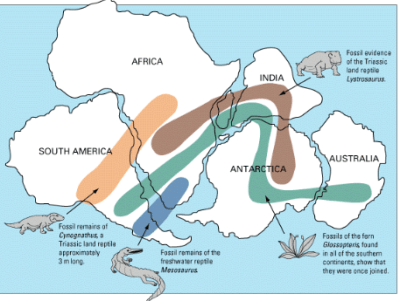
Biogeography was an interesting thing that we learned about this week. It means that organisms found in a particular area tend to be more closely related. This makes esnse because animals have a certain range that would allow them to reproduce more and develop more in certain areas. How did scientists connect the similarities in fossils along the southern tip of South America, Africa, India and Australia? Were these fossils from the time of Pangea?
 Sara Irvin- AP Biology