
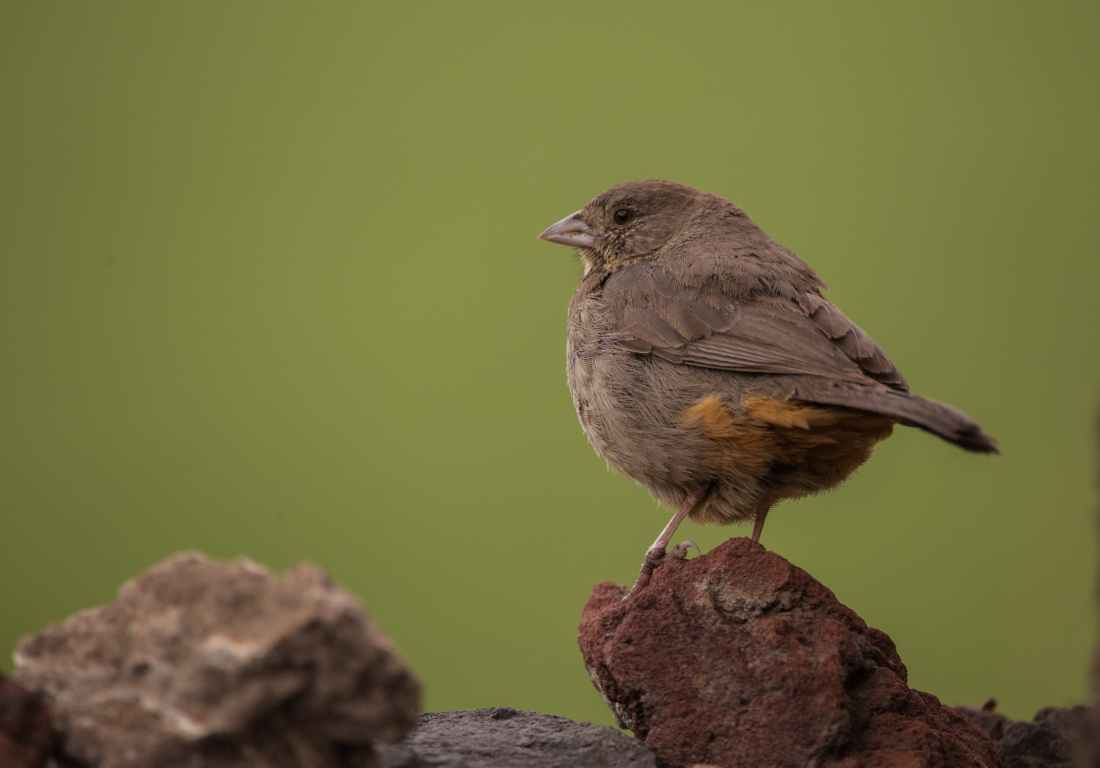
During this week, 9/10-9/14, we started learning about evolution. We used the Galapagos finches and the Rock Pocket mice to visualize and understand natural selection and evolution.
We filled out a packet on the Galapagos finches and discussed how evolution, adaptations and natural selection had played a role in their survival. Peter and Rosemary Grant are ecologists who studied medium ground finches on Daphne Major, an island in the Galapagos, and saw evolution happen in just a small amount of time. During the drought of 1977, the small seeds on the island were harder to find so the finches that had small beaks had a difficult time finding food to eat because their beaks were too small to eat the large, spiny seeds. Many of the small beaked finches died off while the large beak birds survived at much higher rates.
The birds with large beaks had a higher fitness and were adapted to survive better than the small beaked birds in this environmental situation. Now the interesting part was what happened the next year when Peter and Rosemary came back to the island and measured the beak sizes of the offspring. The next generation of finches had larger beaks on average than the generation before them. The finches that survived the most had large beaks and passed this gene onto their children. This is how natural selection, the organisms that were ‘selected’ by their environment to survive and reproduce pass their successful traits onto their children, creating a more fit generation.
We also learned about the Rock Pocket mice. They were also used to demonstrate natural selection and evolution. The tan mice were hidden from predators in the sand but stood out on the black rock. The dark mice were first caused by a mutation in the tan mice population but since the trait was favored for the dark rock environment, those mice survived and passed on that adaptation. Eventually, the population of Rock Pocket Mice living on the black rock was almost exclusively dark mice while the population of mice living in the sand was predominately made of tan mine.
Natural selection is a process where fit organisms that have adapted to their environment will survive and reproduce and those that don’t have the correct traits won’t survive, which is how species adapt and get better over time. While evolution was previously thought to take a long time and many, many generations, the work of the Grants and the example of the Rock Pocket Mice prove that nature is constantly evolving and that natural selection can be seen in just a few generations.
Mutation and reproduction are ways that species can increase variety that will help sections of the species survive even if part of the population is wiped out by natural selection.
What I’m wondering coming off from this week is how will the changing environment force humans to adapt? Since we as a species have more control over our environment and have better technology than any other species, is evolution different for humans than other organisms or are we changing in similar ways to other species?
 Sara Irvin- AP Biology