
This week we focused on learning about Speciation. Speciation is basically how populations evolve into separate species, otherwise called reproductive isolation. First we have to define a species. The classic definition is a population (or group of populations) whose members can interbreed and produce, viable, fertile offspring. But how would you be able to tell this from looking at fossil records? Species can also be determined by appearance (Morphological), niche/role in their environment (Ecological) or fossils (Paleological).
Speciation, as I mentioned before, is the reproductive isolation of populations. What can isolate a population? There are two main ways that populations can be isolated. The first, and most common, is Allopatric Speciation, meaning “other country.” Allopatric Speciation happens when populations are geographically separated and evolve separately so that if they are ever reintroduced, they would not be able to mate. Sympatric Speciation is more rare and happens when populations are in the same area but still evolve in a way that a portion of the population cannot breed with the rest of the population.


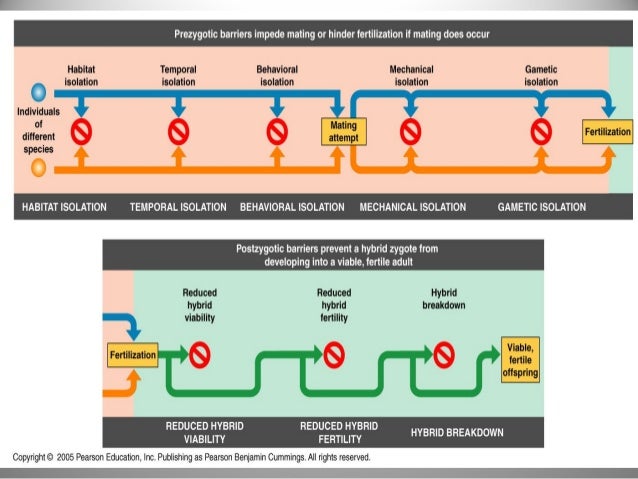
We also learned about species barriers, mechanisms that prevent successful interspecies reproduction. Prezygotic barriers are ones that happen prior to fertilization. They can be things that prevent the organisms from even mating (habitat isolation, temporal isolation and behavioral isolation), or they could be after mating attempt but pre-fertilization (mechanical isolation, gametic isolation). Postzygotic barriers happen after fertilization. This includes reduced hybrid viability, reduced hybrid fertility and hybrid breakdown.
 Sara Irvin- AP Biology